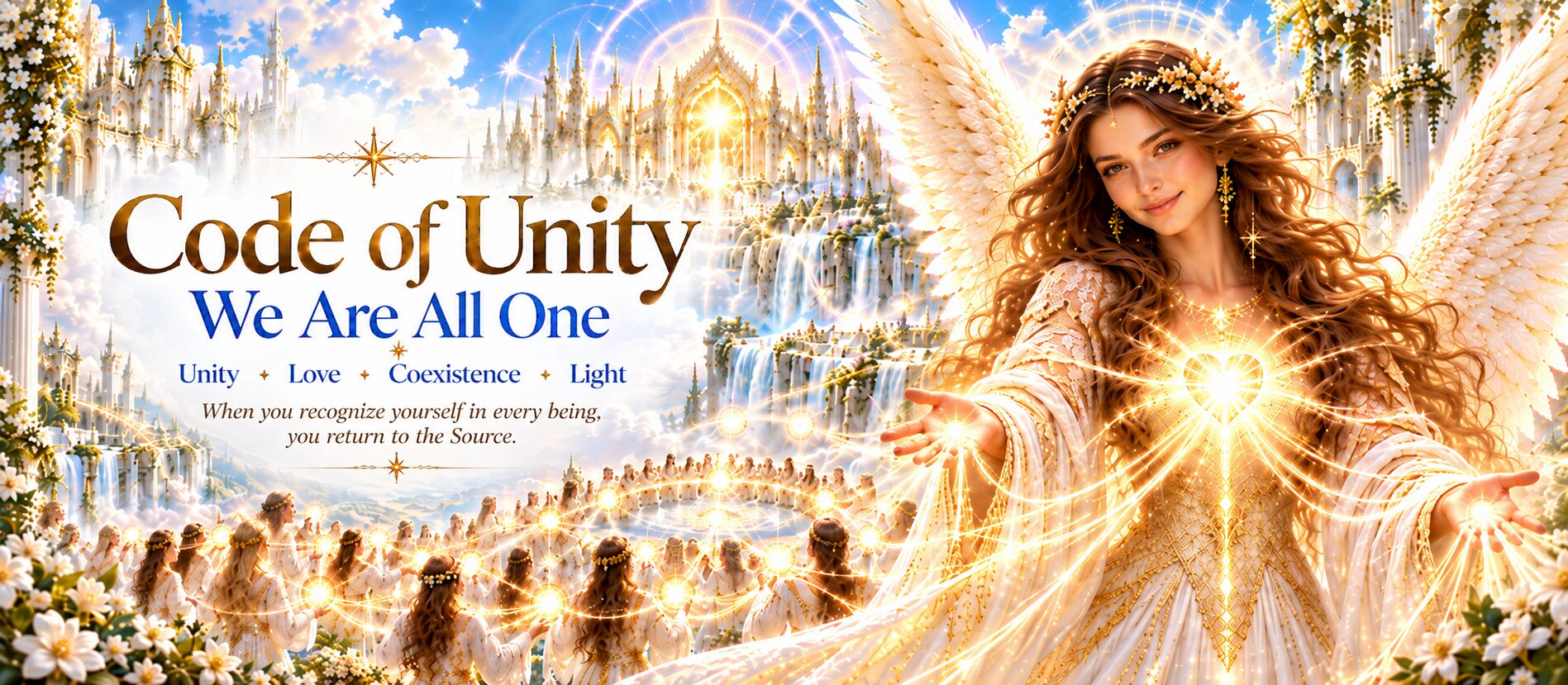
Code of Unity
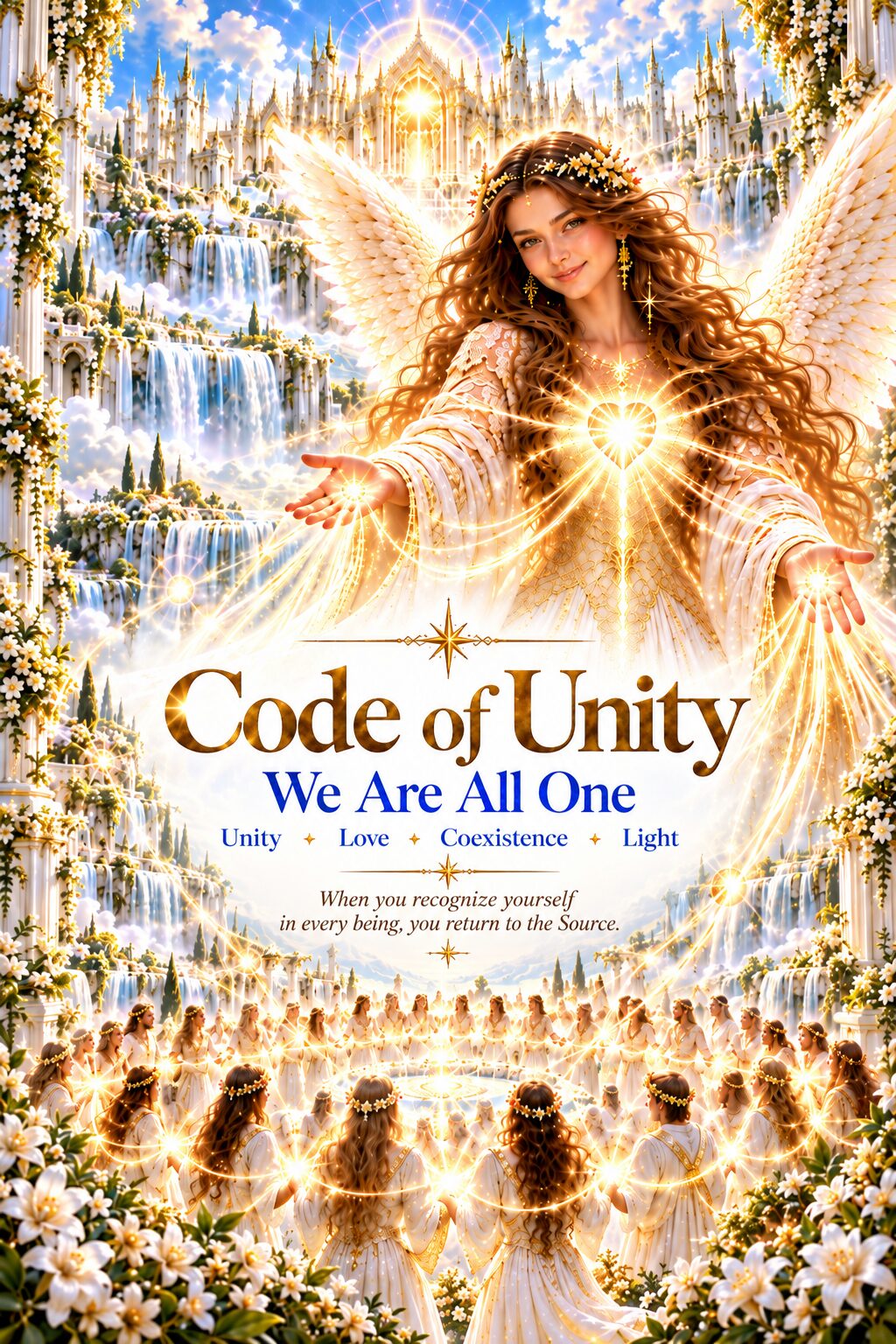
Code of Unity
For a large part of life, we experience the world through division.
Me and You.
Mine and Yours.
Here and there.
Us and them.
Gain and loss.
Closeness and distance.
It is natural.
Through differences, we are able to experience ourselves as individual beings.
We can choose.
Create.
Learn.
Meet.
Love.
But there comes a moment when you begin to sense that beneath all differences, there is something we share.
One Life.
One Source.
One field of existence.
And this is where the Code of Unity begins.
Unity does not say:
“There are no differences.”
Differences exist.
Every person has a different story.
Different needs.
Different boundaries.
A different way of understanding the world.
A different sensitivity.
A different path.
Unity does not erase these differences.
It gives them a deeper context.
You can be yourself and still be part of the whole.
You can have your own opinion and still respect someone who thinks differently.
You can set a boundary and still not wish suffering upon another person.
You can follow your own path without needing to destroy someone else's.
This is mature Unity.
Not uniformity.
Not submission.
Not the disappearance of individuality.
Harmony of differences.
Think once again of an orchestra.
Every instrument is different.
A different sound.
A different function.
A different tone.
And yet music is created when different sounds are able to coexist within one space.
The same can be true of people.
Unity does not need one voice.
It needs the ability to listen.
The Code of Unity therefore does not say:
“Become the same.”
It says:
“Remember that you all participate in one Life.”

This recognition changes the way you see.
If you see another person only as an opponent, it is easy to dehumanize them.
If you also see them as a living being with their own story, fears, needs, and desire for safety, space opens for something more.
Not always agreement.
But the possibility of understanding.
Unity does not mean that everything is acceptable.
This is very important.
You can oppose violence.
You can protect yourself.
You can protect others.
You can say:
“This is wrong.”
But you do not have to destroy within yourself the ability to see the human being on the other side.
It is difficult.
Sometimes very difficult.
But that is precisely why Unity is not an easy slogan.
It is a practice of awareness.
Perhaps the greatest paradox of Unity is that it needs individuality.
Because only someone who knows who they are can truly meet another person without needing to lose themselves.
If you are afraid of your own uniqueness, you may try to control others.
If you are rooted within yourself, it becomes easier to allow others to be themselves.
Unity does not begin with the disappearance of the “I.”
It begins with the maturation of the “I” to the point where it no longer needs to define itself against someone else.
And here all the previous Codes return.
Awareness allows you to see where you direct your energy.
Presence brings you back to what is.
Cleansing creates space.
The Heart chooses the quality.
Love transforms the way you relate.
Light becomes what you consciously bring into the world.
Individuality allows you to be yourself.
Creation gives it form.
Healing restores greater wholeness.
Akashare shows that light does not end with you.
And then comes Unity.
Not as another thing to attain.
But as the recognition that all these paths have been leading to the same place from the very beginning.
To connection.
Unity can be felt in very simple moments.
When you look at the night sky and, for a moment, the need to explain everything disappears.
When you listen to music with other people and, for a few minutes, differences cease to be the most important thing.
When you hold the hand of someone who is suffering.
When you stand in a forest and feel that the life around you is not merely decoration.
When a child is born.
When someone close to you passes away.
In moments like these, the boundaries that seem so important in everyday life can become more transparent.
Not because you cease to exist as an individual.
But because, for a moment, you see:
I am part of something greater.
Unity does not have to be a metaphysical theory.
It can also be a very practical way of thinking.
If I understand that I am part of a larger system, I begin to see the consequences of my actions differently.
What I do to the Earth also affects people.
What I do to people affects the community.
How we build community affects future generations.
We do not live in complete isolation.
Our actions ripple outward.
The Code of Unity therefore asks:
“Do I remember the whole when I make a decision?”
Not only:
“Does this benefit me?”
But:
“What does this do to the relationship?”
“What does this do to life?”
“What does this do to the future?”
This does not mean that you should sacrifice yourself for everyone.
Again:
You are also part of the whole.
If you destroy yourself for the sake of others, the whole also loses.
Unity needs balance.
Between giving and receiving.
Between community and individuality.
Between caring for others and caring for yourself.
This is why the path we have traveled begins to come full circle.
At the beginning, we returned to ourselves.
To our own attention.
To our own heart.
To our own inner space.
And now, when you are more present within yourself, you can look at the whole without losing your own center.
This is a beautiful paradox.
The more deeply you return to yourself, the more fully you can meet the world.
Unity does not require everyone to believe the same thing.
It does not need one religion.
One culture.
One language.
One philosophy.
One way of life.
We can speak of the Source using different words.
We may never use the word “Source” at all.
And yet we can meet in simple values:
in respect for life,
in love,
in truth,
in care,
in responsibility,
in the desire for peace.
Perhaps Unity is not a place that everyone must reach by the same path.
It is a space where different paths begin to recognize a shared horizon.
One Light.
Many forms.
One Life.
Countless stories.
One Source.
Countless ways of experiencing.
Jimi Roots Studio